
About Zaytuna College

Our Mission
Zaytuna College aims to educate and prepare morally committed professional, intellectual, and spiritual leaders who are grounded in the Islamic scholarly tradition and conversant with the cultural currents and critical ideas shaping modern society.
In 2009, Zaytuna College was established in Berkeley, California, on the foundation of a thriving community committed to studying the Muslim classics. Combining this vigor of learning with the best practices in academia, the College opened its doors with a mission to produce God-conscious learners who are conversant in both past and present, through a traditional liberal arts education.
Liberal arts, in its original sense, meant a rigorous study of learning skills (trivium) and
specific subjects (quadrivium). The same structure characterizes the traditional education of the Muslims–indeed, liberal arts
education came to Christendom from Islam, as the late George Makdisi demonstrated in his seminal work, The Rise of
Colleges. By understanding grammar, rhetoric, and logic, a student is equipped with the tools
to approach any discipline.
Zaytuna
College seeks to recapture this tradition through both the BA and MA programs, with a
curriculum that draws both on the Muslim classics and on the Euro-American classical
tradition that grew from and alongside it. Its aim is to cultivate young men and women committed to truth,
goodness, and beauty, in the obedience of our Creator and service to His creation.
The Zaytuna College Campus
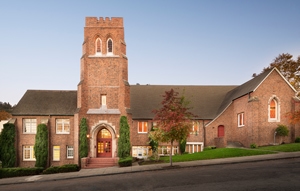
In summer 2015, Zaytuna completed its move to the neighborhood of Holy Hill, a multi-faith academic community in Berkeley, California, where the College owns three buildings, collectively known as the lower campus.
Zaytuna’s lower campus is adjacent to one of the premier research universities in the world, the University of California, Berkeley. Holy Hill is also home to the Graduate Theological Union (GTU), the largest consortium of seminaries and academic centers for the study of religion in the nation.
This community gives Zaytuna’s students and faculty an unparalleled opportunity to engage inside and outside the classroom with educational communities from different faith traditions.
The lower campus comprises three buildings:
2401 Le Conte Avenue (Zaytuna Bookstore, the Sanctuary, and administrative offices)
2479 Le Conte Avenue (student apartments)
1712 Euclid Avenue (male students' dormitory)
Zaytuna’s second location, the upper campus, is a nine-acre property in the Berkeley Hills at 2770 Marin Avenue, consisting of eight buildings (including a women’s dormitory, classrooms, permaculture garden, and administrative offices) and a stunningly beautiful natural environment conducive to serious study.
"The greatest, truest, and only permanent good bestowed upon humanity is that of true knowledge. From such knowledge, all other goods flow, even faith. And this is why, at Zaytuna College, we have adorned our seal with the prayer Qul Rabbi zidnī ‘ilman (“Say: O Lord, increase me in knowledge”).
For it is our knowledge of the world alone that enables us to discern a creator; hence true knowledge will always lead to true faith. The greatest Qur’ānic commandment is “Know that there is no god but the One True God.” It is knowledge alone—and most importantly, knowledge of God—that differentiates us from beasts, making us unique among God’s glorious creation."
– The Qur’anic quotation is from sūrah Tā Hā, verse 114.
What Our Supporters Say
I can’t thank your college enough for bringing some of the beautiful teachings of Islam to our society here in UK. Keep up the good work and please don’t forget to share as much as possible on YouTube or other avenues.
Asrar, United Kingdom
Truly what Zaytuna is teaching is absolutely critical. We need Zaytuna, we need strong, intellectual, balanced muslims that unite the inner and outer sciences and work to perfect their character. May Allah provide for Zaytuna!
Mehran, Canada
I wholeheartedly believe in Zaytuna and in the future of its Muslim intellectuals. May Allah bless Zaytuna with His light and make its students the leaders of tomorrow that we so desperately need.
Subuk, California
Join a Legacy with an Endowment Gift
"Those who give, out of their own possessions, by night and by day, in private and in public, will have their reward with their Lord: no fear for them, nor will they grieve."
(Qur'an 2:274)